
this is an unedited work of art.

OBINNA
APAPA’S WAREHOUSE REEKS OF DIESEL, the metallic tang of rust, and the acrid scent of fear-induced sweat. I learned from a very young age to recognize that sharp, almost sweet, chemical signature. Despite its lovely aroma, the scent is most appropriate for individuals who acquire it by being rather naughty.
Chuks walks three steps ahead, his shoulders filling the corridor. Two of my security detail flanking the entrance stand silently, gazes fixed forward, not acknowledging our presence.
It’s been two weeks since I let her go.
Two weeks since I watched her walk out of that holding room—spine straight, defiant, tall even barefoot—and thought: she’ll stop now. She’ll understand what’s at stake and she’ll stop.
She didn’t stop.
She’s digging harder. Her latest moves suggest she’s exploring the limits of my empire, seeking a weakness.
But that’s not why I’m here.
I’m here for the man in the chair.
Mid-forties. White shirt that probably looked expensive twelve hours ago. Now it’s damp, creased, the collar dark with sweat or… blood. Hard to tell.
His wrists are zip-tied to the armrests. Professional. Not cruel—we’re not animals.
He looks up when I walk in.
He says, “Ódògwù…” with a pleading voice that’s all over the place.
I pull a chair from the corner, the metal loud against concrete. I sit, cross one leg over the other, and study him like a balance sheet. I’m looking for the line item that doesn’t add up.
“Chimobi…”
I know his name. I know his wife’s name, his daughter’s school, the mortgage on his house in Lekki Phase 2, the car he bought last month—the one that should have been a red flag to his supervisors, because a mid-level finance manager at PuntPlay does not drive the latest GLE.
He swallows.
“Four hundred and twelve million naira,” I say, like I’m reading from a menu. “Skimmed over fourteen months from the West Africa expansion fund. Routed through a shell account in Cotonou—very creative, I’ll give you that—then washed through your cousin’s logistics company in Onitsha.”
His breathing changes.
“Your daughter starts at Greensprings next term. Fees are, what—four million a year? Your wife’s shop in Tejuosho turns maybe six hundred thousand monthly. Your mortgage is one point two million quarterly.” I sigh. “The math is not mathing, Chimobi.”
“Ódògwù—please, I can explain—Ódògwù —”
“I’m not asking you to explain. I’m not.” I say in a placating tone. “I’m telling you what I know. Your explanation is irrelevant because we both know what happened. You saw money that wasn’t yours, and you took it. The question isn’t why—greed is boring and universal. The question is: who else?”
His eyes dart left. A small involuntary micro-expression.
“Because you’re not smart enough to build that Cotonou route alone. And your cousin in Onitsha is a drunk who can barely manage his books. Someone showed you the gap. Someone told you where to push.” I lean forward, elbows on my knees. “Give me the name, and your daughter still goes to Greensprings.”
The silence that follows is deafening.
He breaks in under ninety seconds. They always do.
Hmm.
The name he gives me is interesting. Not who I expected. Oh well… measures have to be taken.
I stand. The metal chair scrapes against the concrete again. I button my jacket.
“Chimobi.”
“Ódògwù. Biko. Enwere m ezinụlọ—Ódògwù —”
Ah… playing the kinship card? As a polyglot, I love that when English runs out, people reach for the language closest to their bones.
He looks up with wet eyes, runny nose, his dignity somewhere on the floor between us.
“Everyone has a price, Chimobi. Yours was embarrassingly low.”
I leave him breathing and alive but broken in the ways that matter—reputation, leverage, the illusion that he could steal from me and still sleep well. But breathing. I’m not my father. Umendiego would have taken the man’s house.
Me? I just took his options.
My ex-wife called this my black heart. She wasn’t wrong.
Chuks holds the car door open as I slide in, grateful for the air-conditioning.
The gentle sway of the car lets me close my eyes, breathe deep, decompress and reset.
I don’t enjoy that. The warehouse. The seeing a grown man cry. Dismantling his defenses until he gives me what I need. Noticing how his breath shifts when he realizes I’m not bluffing. The exact moment the fight leaves his body.
I don’t not enjoy it either.
That’s the part Justina couldn’t live with. Not the money, not the travel, not even the women—yes, there were women, I won’t pretend otherwise. In the end, she left with one of the houses in Buckhead and a settlement that would make most men weep.
I didn’t weep. She said that proved her point.
She might have been right about that too.
But here’s what Justina never understood, what nobody outside my blood understands: yesterday morning, I was making dinosaur noises for a nine-year-old, promising his seven-year-old sister I’d bake blueberry muffins on my next visit, letting Kamso lecture me about Tylosaurus apex predators while Kodi negotiated the number of the muffins we’d bake.
The warehouse and the muffins co-exist in the same heart.
Chuks pulls into traffic. Apapa to Banana Island is a journey measured not in kilometers but in patience, and Friday traffic is God’s personal joke on anyone foolish enough to have somewhere to be.
“That Nentawe woman,” Chuks says, eyes on the road. He delivers information the way surgeons deliver diagnoses—without inflection, leaving you to decide how to feel about it.
“What about her?”
“Ódògwù, she’s not stopping. She called the office again this morning. She called three times. Sent another email to legal asking about licensing structure for the West Africa expansion.”
I watch the city crawl past the tinted window. Danfo buses. Hawkers weaving between bumpers with their wares. A woman in a blue wrapper with two kids crossing four lanes of traffic like the overhead bridge was hung there for decoration.
I should have expected this.
Two weeks ago she sat across from me in that holding room with silk blindfold marks fading on her face, and she looked at me unafraid. Calculating. Cold-storm eyes cataloguing me the way I catalogue investments—measuring return, assessing risk, finding the angle.
I’ve sat across from warlords and oil barons and men who make you look like a schoolboy playing dress-up, she’d said.
No one talks to me like that. No one calls me a schoolboy. No one looks down at me and tells me I’m playing dress-up in a room where she’s the one in cuffs. No one.
Yet I let her go.
“Forward the emails to Taiwo,” I say. “Let legal handle it.”
“Legal said she’s asking different questions now. Not is PuntPlay a scam or are you ruining Nigerian youths. She’s asking about regulatory approvals. Which agencies. Which officials. The blueprint of the West Africa expansion.”
Impressive. Smart questions. She listened, then. When I told her she was building a simple story while the truth was complicated, she listened.
“I think she’s not just investigating PuntPlay anymore,” Chuks continues. “She’s investigating the framework around it. The regulators. The policy gaps.”
“Keep monitoring,” I say. “But no interference. She wants to dig, let her dig. Just tell me where the shovel points.”
“Understood.”
I have bigger problems than a journalist who won’t stay scared.
Former NLRC chairman and current WAGER vice-chair has been circling the West Africa expansion for months now, like he can smell the money all the way from his mansion in Maitama.
The man practically wrote modern sports betting regulation in Nigeria. Then retired with a handshake, national honors, and enough political goodwill to last three lifetimes. Only to quietly build shadow companies designed to exploit every loophole he personally authored into law.
He wants in. Or he wants me out. Either way, he’s filed a regulatory complaint with the NLRC—some nonsense about our licensing framework violating section 47(b)—and it’s slowing my timeline.
My personal phone buzzes. The screen shows a photo of a man with dreadlocks wearing glasses and grinning.
“Obinnaya.” The way he says my name—full, unhurried, like he’s tasting every syllable—is uniquely Jidenna. “Where you dey nau?”
My dearest twin brother. Born seven minutes after me, though he insists those seven minutes gave me an unfair advantage I’ve been exploiting ever since.
“I’m in traffic.”
“Waka waka. Traffic where?”
I smile. “I never travel. I dey Lagos. What do you want?”
He pauses. Listening. To what, exactly, I’ve never been sure. God, the universe, the peculiar frequency that runs between us. When we were boys in Atlanta, he’d wake up crying from nightmares that were mine. I’d feel his fevers before he told anyone. Our father called it nonsense. Our mother called it a gift, twin bond, telepathy.
“The balance has shifted.” His voice drops—not to a whisper, but to the register he uses when he’s not being my brother but being whatever else he is. The part of him I don’t fully understand and have learned not to question. “Two weeks ago, I felt a change. I told you then, but now it’s different. Now it’s… unsettled. Like a frequency that hasn’t found its note yet.”
I shift in my seat. “Oga, I’m coming from a warehouse where I literally destroyed a man’s career on over four hundred million theft. I’m not in the mood for frequency distribution or spiritual punditry.”
“This isn’t about business. Well, not directly. Let’s see—what have you done differently recently?”
“Abeg, I don’t know what you’re talking about.”
“You’re lying. I can feel it all the way from here.”
“Then stop feeling. Develop a black heart.”
He lets out a short, warm laugh. “You’re still carrying what she said about you having a black heart to heart?”
I look at his face on the screen. My twin. Brown-skinned where I’m fair—he took after our mother, Hafsa, who is from Borno State. I took after our father, Umendiego. In complexion, my jaw, even in temperament. Things people praise in a man and pity in a husband.
Jidenna’s dreadlocks frame his face. He arrived with them—born with thick, tangled strands that neither dad’s family nor Hafsa’s could explain. Not a single ancestor on either side carried that hair. Our grandparents recommended the sàrà àká tradition: cut them off, appease whatever spirit sent them. Hafsa refused. Leave my son’s hair, she told them. And that was the end of the conversation.
“Jokes aside, bro. I need you to pay attention,” Jidenna says. “Not to your moves or strategies. Definitely not to the board. To yourself. I need you to pay attention to you. When was the last time you were still? When was the last time you stopped thinking, stopped planning? The last time you just… chilled?”
I don’t answer. Because the answer is I don’t remember, and he knows it.
“The frequency that shifted two weeks ago—it hasn’t settled. It’s still looking for its note.” He pauses. “I think you’re part of what it’s looking for. And I think you’re afraid to let it find you.”
I scoff. “Oga. Me. Afraid?”
“Yes, I believe so. The question is whether you let it run you or you run it.”
He hangs up. Seven minutes younger and still so annoying.
I stare at the phone, then out the window. Traffic hasn’t moved.
I roll his words around. Jidenna has been doing this since we were fifteen—calling at odd hours, saying things that sound like riddles and prophecy. When he told me not to sign with the first investors for PuntPlay, I ignored him. Lost eight months and twenty million learning he was right. When he told me Justina would leave, I laughed. Signed divorce papers six months later.
I don’t ignore Jidenna anymore.
Okay, I do, sometimes.
Because I’m human and he can be annoying.
I toss the phone onto the seat, adjust my silver cufflink, and think about Hafsa. She sounded really tired last week and had the nerve to lie to me that it was lack of sleep.
I think about daddy in Atlanta, running his empire with Agozie beside him, expecting results from me the way the sun expects the earth to turn.
I think about PuntPlay, the business that made me Ódògwù before I inherited the title.
I think about Chimobi in that chair. The way his eyes went flat the moment he realized I already knew everything.
And I think about her.
That journalist. Miss Nentawe.
Now that she’s digging harder, the smart play is to have her discredited. A word to the right editor. A whisper about conflicts of interest. Pressure that doesn’t leave fingerprints.
I don’t make the call.
Instead, I watch the city crawl past the tinted window.
Isn’t it wild that the first person in ages who doesn’t flinch at me is the one going after everything I’ve built?
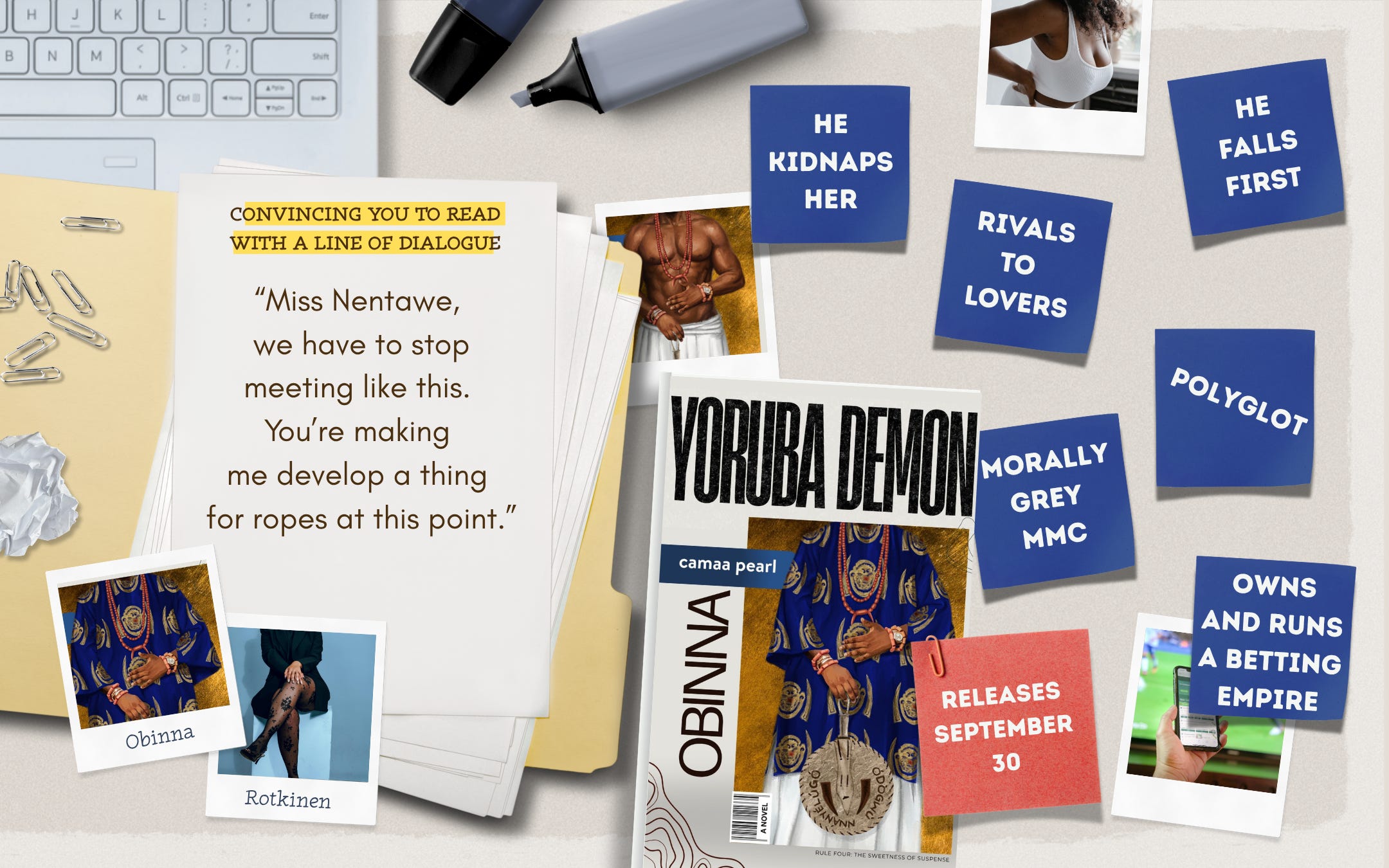
40+ Chapters to go…
Releases September 30, 2026.
Active like chivita 😝🤭
I can't wait oo